Syntax Interrupted in the Linguistic Structure of Ruins and the Aftergrammar of Bombed Civic Space in Ukraine
- Tom Denman

- Feb 13, 2023
- 4 min read
Updated: Jun 16
Walking into Fault Lines of Speech: Ruins Collected from a Sentence at Atticus Art Gallery in Bath, one does not encounter a conventional exhibition. There are no didactic panels, no descriptive placards seeking to direct the viewer’s interpretation. Instead, one enters a site of semantic suspension—a space where the architectural residue of war appears not as spectacle, but as fractured grammar. In Oleksandra Nikitina’s latest exhibition, language has not vanished. It has been bombed into stutter.

Nikitina, a Ukrainian-born artist now based in the UK following Russia’s invasion of her home country, has long interrogated the porous boundary between civic architecture and public speech. Trained as both a spatial theorist and visual artist, her practice dwells in the interstice between structure and syntax, ruin and remembrance. Her work refuses to be read as political commentary—it is political condition, made material.
In 2020, her exhibition The Silence of Clauses—a haunting meditation on linguistic erasure and architectural ghosts—garnered international recognition, winning the Boven Verwachtingen Prijs in the Installation Category in the Netherlands. That project marked a turning point, establishing her not only as a conceptual force but as an artist with rare structural eloquence: one who translates geopolitical trauma into an exacting language of space and residue.
Fault Lines of Speech is on view at Atticus Art Gallery, Bath, UK, from 9 February to 14 April 2023. Curated by Thomas Bloor and organised in partnership with the Ukrainian Institute London, Architects for Peace, and ArtAid Ukraine / Eastside Projects Birmingham.
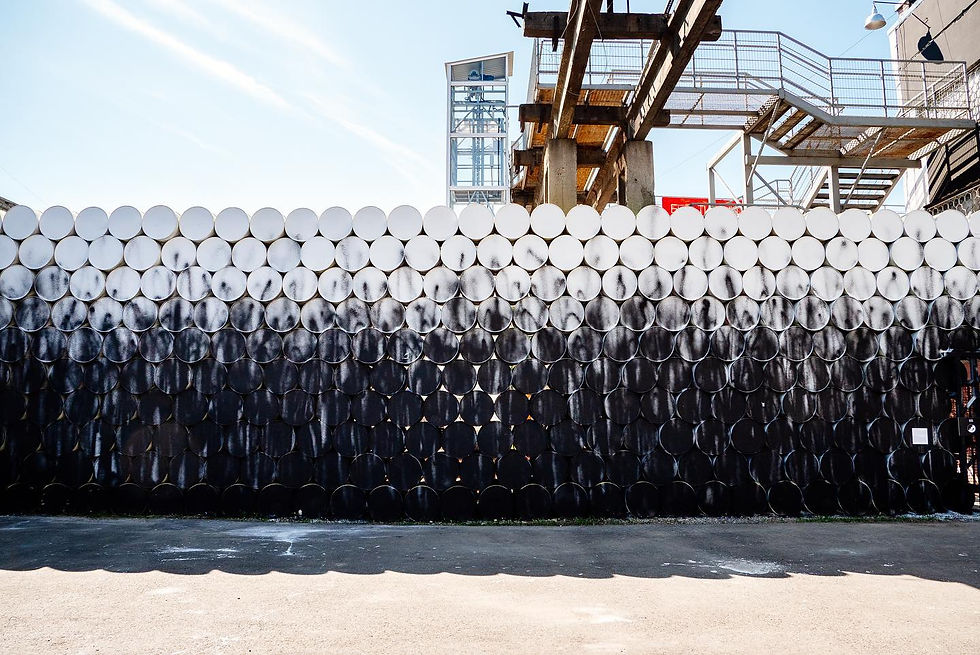
Drawing on architectural fragments salvaged from bombed public spaces across Ukraine—schools, theatres, archives, and state buildings—Nikitina composes structures that refuse to behave like art. They do not posture. They do not symbolise. They remain, quietly, as if stunned into grammar. One piece, consisting of blackened metal frames and scorched surfaces, resembles a phrase mid-collapse: a wall that tried to house meaning, now reduced to uncertain syntax.

Her previous exhibitions—The Silence of Clauses (2020) and Architexts (2022)—framed bureaucratic and cartographic systems as fossilised languages, where political intent remained encoded in abandoned structure. But in Fault Lines of Speech, she arrives at something more immediate, and more devastating: the aftergrammar of crisis. These works are not ruins romanticised; they are civic clauses bombed into stutter.
The title itself provides a theoretical framework. Fault Lines implies both seismic activity and structural weakness. In Nikitina’s world, these lines are grammatical, juridical, territorial. Speech is no longer legible. It cracks along its built substrate. And yet, something endures—not quite language, but the memory of its architecture.
Central to the exhibition is a sculptural configuration resembling an evacuated archive. Filing units—twisted, rusted, fire-singed—stand as emblems of lost administration. Their drawers gape or jam; their contents have turned to ash. This is not metaphor. It is epistemological failure made visible: the moment when the state's capacity to record, file, remember is scorched beyond retrieval. Nikitina’s term for this work—The Archive Without Language—is not a title, but a verdict.
Another work—neither model nor diagram—offers a subtle cartographic gesture: Crimea, presented as pale relief, integrated unequivocally into the Ukrainian topography. This map, uncaptioned and devoid of boundary lines, performs its own speech act. It does not declare. It refuses erasure. In a show dominated by mute structures, this gesture is linguistic through subtraction—a sovereign assertion made quietly through form.
What distinguishes Nikitina’s work is its refusal to aestheticise trauma. These are not installations as symbolic commentary. They are syntax made of matter, composed from the linguistic detritus of civic space. Her use of materials—charred wood, broken concrete, twisted metal—is never theatrical. It is always procedural, almost forensic. One senses the artist operating not as sculptor, but as philologist of ruin—cataloguing the ways in which language persists, even when its container has been annihilated.
Curator Thomas Bloor, in collaboration with partners including the Ukrainian Institute London and Architects for Peace, has done well to let the work speak in its own broken tongue. The installation avoids curatorial over-explanation, leaving space for viewers to reckon with the emotional and political complexity of dislocated speech. The exhibition resonates not just through its material presence, but through the grammatical disorientation it engenders. One leaves not with answers, but with fragments.
Fault Lines of Speech makes one fundamental claim: that language, once spatialised in institutions, does not vanish under bombardment. It mutates. It trembles. It becomes ungrammatical. And in doing so, it gains a new, terrifying eloquence.
Nikitina has not staged a memorial. She has built a sentence that cannot finish.
Atticus Art Gallery (11a Queen Street, BA1 1HE, Bath)
For more information, visit atticusartgallery.co.uk
Tom Denman, residing in London, is a distinguished freelance art critic whose perceptive articles have featured in eminent publications such as Art Journal, ART PAPERS, ArtReview, Art Monthly, Burlington Contemporary, e-flux, Flash Art, Ocula, and Studio International. He earned his PhD in Italian Studies from the University of Reading, focusing his research on Caravaggio and the noble-intellectual milieu of seventeenth-century Naples. Presently, his critiques primarily explore the subtleties and emerging trends within contemporary art.


Comments