top of page

Combustion Without Witness

  • Writer: Tom Denman
    Tom Denman
  • Sep 14, 2023
  • 4 min read

Updated: Jul 25

Anna Viktorova’s “Reduction Atmosphere” at Atticus Gallery, Bath, UK | 14 September – 5 November 2023

What unfolds within Reduction Atmosphere is not an exhibition but a thermal event belatedly endured. Anna Viktorova—whose raku-fired practice increasingly operates outside the domain of form and within the charged space of aftermath—constructs an environment in which combustion is not staged but metabolised. Here, fire is not represented but recalled as chemical absence: a violence felt only by what has survived it.

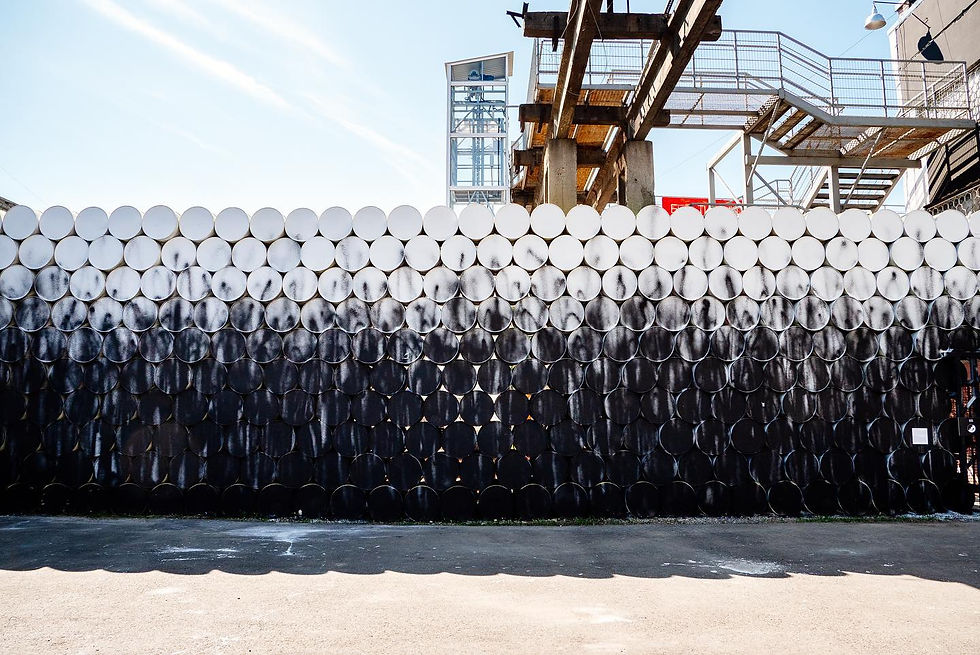
The installation—staged within a circular black chamber cut only by a single overhead aperture—evacuates the viewer of interpretive agency. There are no didactics, no wall texts, no framing devices. Light is minimal, nearly extinguished. Context is occluded. What one enters is not a curatorial space but a sealed, post-combustive chamber: a kiln arrested in its moment of cooling, where the work has already passed through rupture and now hovers, traumatically, in its wake.

Viktorova does not offer objects for admiration. The vessels—charred, blistered, chemically unstable—are neither sculptural propositions nor symbolic placeholders. They function instead as material testimonies: heat-distorted residues of an elemental procedure. Born of raku firing—a violent thermal shock process where vessels are extracted from a kiln at incandescent temperatures and exposed to oxygen-starved environments—they carry the inscription of fracture, suffocation, and metamorphic loss. Viktorova radicalises this tradition not by aestheticising its surfaces, but by weaponising its conditions. The reduction atmosphere, conventionally a technical term denoting oxygen deprivation in ceramic firing, becomes here an ontological and political atmosphere: a space of erasure, withholding, and irreversible change.

This is not a field of sculpture, but of decomposition. Glazes crack, oxidise, drip across contours like memories unable to hold form. Ash, steel filings, and degraded resins become ungovernable inscriptions across ceramic skin. The logic is not compositional but entropic: every element tilts toward breakdown, undoing, and decay. What is exhibited is not the artefact but the wound it retains.

The spatial organisation affirms this disintegration. There is no centre, no privileged object, no vantage from which a viewer might command comprehension. Everything flattens into equivalence: a democratic field of ruin. To navigate the room is not to observe but to dwell, uneasily, among the residual. The viewer is not positioned as a spectator of process, but as cohabitant of its irreversible consequences.

The exhibition’s refusal of resolution is echoed in its temporal resistance. Nothing here is complete. The works remain chemically active, susceptible to ambient humidity, light, and the presence of the body. In this, Reduction Atmosphereeludes the museum’s will to conservation. It is an anti-archival gesture. Each object insists on its instability, its porousness, its capacity to continue degrading. Viktorova refuses the closure of form and the safety of objecthood. What she offers instead is duration without fixity—a mode of presence that remains perpetually at risk.

Her refusal to fix meaning is not merely aesthetic but deeply political. It resonates with Jane Bennett’s material vitalism, in which matter is not inert but always in motion, always exceeding human control. These ceramics are not objects but agents—unruly, unstable, continuously becoming. Likewise, Jack Halberstam’s concept of “unbecoming” as a queer political gesture haunts the exhibition: nothing here is stable, nothing is whole, and that very refusal is its mode of resistance.

Viktorova’s installation also draws conceptual energy from Sara Ahmed’s reading of orientation: the idea that affect emerges from how bodies encounter objects, spaces, and atmospheres. The viewer here is not aligned with clarity or visibility, but with disorientation—tilted into a space where breath is withheld and comprehension delayed. One does not stand in front of the work, but beside it, in proximity to collapse.

And finally, the work echoes Hito Steyerl’s insistence that the contemporary condition is one of resolution loss—not just optical but epistemological. In Reduction Atmosphere, there is no clear image, no stable object, no clean data. What remains is a smear of heat, a bruise of combustion, a blur where something used to be. Meaning, if it ever existed, has been scorched away.

The conceptual stakes of this refusal resonate with broader materialist philosophies. Karen Barad’s theory of intra-action finds clear resonance here: Viktorova’s vessels are not autonomous objects but emergent phenomena—relational condensates of fire, oxygen, clay, and trauma. Equally, Christina Sharpe’s concept of “residence in the wake” hovers over the installation’s logic: this is not a depiction of catastrophe but a choreography of its persistence. The work does not narrate trauma—it inhabits its temperature.

There is also, in the atmosphere of forced breathlessness, an echo of Édouard Glissant’s right to opacity. The viewer is not invited to decipher but to endure; not to interpret but to remain near. Meaning is neither promised nor deferred—it is rendered beside the point. What matters is proximity: the charged distance between the viewer’s skin and the ceramic’s cooling surface, between breath and ash, between rupture and its residue.

Reduction Atmosphere stages no spectacle. It does not perform grief, it does not aestheticise collapse. Its power lies in its quiet refusal to resolve. What distinguishes Viktorova’s work here is not its formal innovation—though it is rigorous—but its ethical rigor: the insistence that some violences should not be seen, only endured; that some transformations, once set into motion, must be lived beside, without interpretation, without witness. This is combustion not as drama, but as condition. Not fire as metaphor, but as memory, still burning inwardly, unseen.

As part of the exhibition’s public programme, a panel discussion organised by The Centre for Arts, Research and Culture (CARC) will take place on 18 October 2023 in the gallery’s lower level. Titled Atmospheres of Suspension, the event will bring together Viktorova with UK-based raku practitioners Wendy Lawrence, Diana Tonnison, and Nigel Edmondson for a conversation on combustion, instability, and the ethics of material residue. Framed as a collective enquiry rather than a traditional artist talk, the session reflects CARC’s commitment to experimental research and expanded forms of artistic discourse.

Atticus Art Gallery (11a Queen Street, BA1 1HE, Bath)


 Tom Denman, residing in London, is a distinguished freelance art critic whose perceptive articles have featured in eminent publications such as Art Journal, ART PAPERS, ArtReview, Art Monthly, Burlington Contemporary, e-flux, Flash Art, Ocula, and Studio International. He earned his PhD in Italian Studies from the University of Reading, focusing his research on Caravaggio and the noble-intellectual milieu of seventeenth-century Naples. Presently, his critiques primarily explore the subtleties and emerging trends within contemporary art.

Comments


Top Stories

Stay up-to-date with the latest art news and events by subscribing to our monthly newsletter.

Thank you for subscribing!

  • Instagram
  • Facebook
  • Twitter

© 2021 Art News Monthly. All rights reserved. Website powered and secured by Wix.

bottom of page